


Metrum


Haec commentatio de longitudine narrat. De alia significatione videatur Metrum (discretiva).

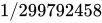
Metrum[1] (-i, n.; Graece: μέτρον, via Francogallice mètre) est mensura principalis (Anglice: base unit[2]) longitudinis, una ex septem principalibus physicae mensuris in Internationali Unitarum Systemate (Anglice: International System of Units). Definitio, primum excogitatum ut 10 000 000 pars spatii ab aequatore ad Polum Septentrionalem, continenter expolitur ut auctum metrologiae scitae implicet. Post die 21 Octobris 1983, metrum definitur ut spatium a luce transitum in vacuo 299 792 458 parte secundi.[3]
Definitio[recensere | fontem recensere]
Vetus[recensere | fontem recensere]

Anno 1793 metrum primum definitum fit. Definitio erat metrum esse partem meridiani orbis, qui Lutetiam percurrit. Anno 1795 primum exemplar in metallo orichalco factum et anno 1799 exemplar finale, quod "metrum ordiale" nominatur, in metallo platino funditum est.

Mensurae exactiores telluris in saeculo undevicensimo effectae monstrabant priorem mensuram falsam fuisse. Novum exemplar necessarium erat. Hoc anno, 1889, ab officiis mundi ponderum et mensuris in metallis platino (90%) et iridio (10%) funditum est.
Ab anno 1960 usque ad annum 1983 metrum erat pars producti longitudinis undae in vacuo quae atomus Cryptonis-86 inter affectiones 5d5 et 2p10 mutans generat.

Hodierna[recensere | fontem recensere]
Ab anno 1983, metrum definitur ut spatium quod lumen in vacuo in parte secundi percurrit, ut velocitas lucis subtiliter definita sit sequenti modo

Variae Longitudines[recensere | fontem recensere]
- chiliometrum = 1000 metrorum
- decimetrum = 1/10 metri
- centimetrum = 1/100 metri
- millimetrum = 1/1000 metri
- micrometrum (micron) = 1/1 000 000 metri
- nanometrum = 10-9 metri
- picometrum = 10-12 metri
- femtometrum = 10-15 metri
Nexus interni
Notae[recensere | fontem recensere]
- ↑ Schlickum, O. (1879). Lateinisch-deutsches Special-Wörterbuch der pharmazeutischen Wissenschaften. Leipzig: Ernst Günther’s Verlag.
- ↑ Vide commentarium in vicipaedia Anglica.
- ↑ 17th General Conference on Weights and Measures (1983), decretum primum.
Bibliographia[recensere | fontem recensere]
- Beers, J. S. et W. B. Penzes. 1992. NIST Length Scale Interferometer Measurement Assurance. National Institute of Standards and Technology 4998.
- Bureau International des Poids et Mesures. 17th General Conference on Weights and Measures. (1983). Resolution 1.
- Bureau International des Poids et Mesures. (2006). The International System of Units (SI)
- Bureau International des Poids et Mesures. (n.d.). Resolutions of the CGPM (search facility).
- Bureau International des Poids et Mesures. (n.d.). The BIPM and the evolution of the definition of the metre.
- Layer, H. P. 2008. Length—Evolution from Measurement Standard to a Fundamental Constant. Gaithersburg, MD: National Institute of Standards and Technology.
- Mohr, P., Taylor, B. N., et David B. Newell. (28 Decembris 2007). CODATA Recommended Values of the Fundamental Physical Constants: 2006. Gaithersburgi Terrae Mariae: National Institute of Standards and Technology.
- National Institute of Standards and Technology. (December 2003). The NIST Reference on Constants, Units, and Uncertainty: International System of Units (SI).
- National Research Council Canada. (16 May 2008). Optical Frequency - Maintaining the SI Metre.
- Penzes, W. (29 December 2005). Time Line for the Definition of the Meter. Gaithersburg, MD: National Institute of Standards and Technology, Precision Engineering Division.
- Taylor, B.N. and Thompson, A. (Eds.). (2008a). The International System of Units (SI). United States version of the English text of the eighth edition (2006) of the International Bureau of Weights and Measures publication Le Système International d’ Unités (SI) (Special Publication 330). Gaithersburg, MD: National Institute of Standards and Technology.
- Taylor, B.N. and Thompson, A. (2008b). Guide for the Use of the International System of Units (Special Publication 811). Gaithersburg, MD: National Institute of Standards and Technology.
- Tibo Qorl. 2005. The History of the Meter (conversus a Sibille Rouzaud).
- Turner, J. (Deputy Director of the National Institute of Standards and Technology). (16 Maii 2008)."Interpretation of the International System of Units (the Metric System of Measurement) for the United States". Federal Register Vol. 73, No. 96, p. 28432-3.
- Zagar, B. G. 1999. "Laser interferometer displacement sensors." In The Measurement, Instrumentation, and Sensors Handbook, ed. J.G. Webster (CRC Press, ISBN 0849383471).
 | |
|
yoctometrum • zeptometrum • attometrum • femtometrum • picometrum • nanometrum • micrometrum • millimetrum • centimetrum • decimetrum • metrum • decametrum • hectometrum • chiliometrum • megametrum • gigametrum • terametrum • petametrum • exametrum • zettametrum • yottametrum Capsae cognatae: Magnitudines | |
 | |
|
Unitates axiomaticae: | |